
Contents
Dear friends,
I’m writing this in the Summer of 2026, with the start of my PhD around the corner and the 2027 admissions cycle just beginning for many of you! As more and more thoughtful questions about the process find their way to my inbox, I wanted to take some time to put my thoughts/reflections down in one place for you guys to freely query and follow up on.
As you may have started to realize, the admissions process can be challenging to navigate. I know (very well) that lack of clarity adds unnecessary stress to the application. My hope is to lessen your anxiety a little and offer some structure/perspective on what the next couple of months might look like.
A big motivation for writing this is the example set by Lucy Lai (https://lucylai.com/blog/gradapps) and Ya’el Courtney (https://www.yaelcourtney.com/phdapplicationguide), whose guides were an immense help to me as I was gearing up to do this last Fall. I want to extend my gratitude to them and the many other generous colleagues who have contributed their time to demystifying this process for all. And, in the spirit of giving back, contribute my own little piece.
I will also link my Caltech statement of purpose here so you guys have a template to reference, should you need it!
A bit of background
- I applied as a Senior at Harvard. I concentrated (majored) in Neurobiology and also pretty extensively explored the stem cell/regenerative biology department’s courses.
- I spent 3 (wonderful) years in Bernardo Sabatini’s group (mentored by Kevin Mastro), where we investigated a number of questions related to circuit changes across the lifespan (adolescence, aging). I led a thesis project and contributed to a couple additional projects through the years.
- I also very fortunately had the opportunity to learn genetic engineering in George Church’s group (mentored by Juseong Lee), where I built all sorts of constructs!
- My pride and joy through undergrad was the OpenBio Lab, which I led from 2025 to 2026. I believe very deeply in the power of citizen scientists and the future we can build as a generation equipped with biological know-how + tools. OpenBio’s overarching goal is to realize this democratization through a bunch of cool initiatives we run. I’d highly encourage you to check it out!
Application-specific caveats
- I applied only to fully-funded rotation-based neuroscience/biology PhD programs (primarily in the US).
- I did not take the GRE (as it was not required by my programs)
- In Addendum, I’ve asked friends doing their PhD elsewhere in the US, the UK, and China to write in additional thoughts
The timeline
After some consideration, a sensible way I thought to lay this out would be to:
First, discuss a couple key checklist items for the year or so leading up to the cycle.
Then, go chronologically by month through the cycle, with what I did & what I wish I had done/done better.
One year before
The application cycle can be time-, energy-, and money-consuming (application fees add up quickly…). I would strongly advocate that you not rush into it. The best cycle is not necessarily the earliest one; it is the one in which you have (1) enough research depth, (2) strong enough letters, and (3) a clear enough reason to apply.
An accessible initial benchmark is your mentor’s candid assessment. If they think another year would materially strengthen you, you should take that opinion into serious consideration.
Graduate school is not meant to be easy. Structured postbac or research-technician positions exist for a very good reason and are an excellent next scientific chapter meant to prepare you to hit the ground running. Oftentimes this extra training will also make that initial transition so much easier + eventually compound your growth in graduate school (a win-win). Don’t count it out, you will likely thank yourself for that decision later.
Below, I propose three important components that you should have clarity on before deciding it is the right cycle to apply:
-
Recommendation letters (3 of them).
Three letters require some intentional planning, but (contrary to popular belief) they do not require you to have worked in three separate labs.
A strong set might include your (1) primary PI, (2) a co-advisor/faculty collaborator, and (3) another faculty member who has supervised sustained scientific work (school capstones/ thesis projects), or with whom you have built a strong instructional relationship (you excelled in several of their classes or TA’d for them).
As for the letter itself, it is most common that your undergraduate/technician work falls under the umbrella of a postdoc/graduate student’s larger project. Therefore, it is also common practice to have your day-to-day direct mentor contribute detailed examples to the PI’s letter or co-write it. If there isn’t a system like this set up in your lab already, be sure to make that request! In this way, you can combine the strength of your PI’s name with vivid language from someone who knows your work closely!
When you ask for this letter, I would advise you to be polite but direct: “Would you feel comfortable writing me a strong recommendation?”
Importantly, set that “strength” expectation clearly and be prepared for them to say no. This might sting in the moment, but gaining this clarity is a favor to you. The last thing you want is to be disqualified after all the work you put in because of a lukewarm letter.
On timing and content, ask 6-8 weeks ahead when possible (in-person ideally) and follow up with a single packet containing your CV, current statement, deadlines, research interests, and an info-sheet (I’ll elaborate on this in a later section).
Key note: Try to initiate open dialogue about your intention to apply and build this working relationship early on (way before the 6-8 week request period). This is not only important for the letter itself, but for your growth as a scientist! I have personally found that there is so much to learn from experienced and brilliant mentors. You’d really be doing your own growth and work a huge favor by having these conversations early, and often.
-
A significant research project (ideally independently-led).
A PhD is a job (with learning and mentorship embedded). The best way to show you qualify for the job is to have a track record of doing a good job.
Mentors want to know that when you join their lab, you have not only had sufficient experience doing science but also that you can operate as an independent thinking/operating contributor to their group. The strongest evidence is that you can explain exactly HOW you did the work, WHY you made each decision, what you personally contributed, and what you learned.
Concrete outputs (theses, posters, preprints, manuscripts, and peer-reviewed publications), will definitely help substantiate that story, but they are not the end-all-be-all of intellectual ownership. As such, most interviews will also revolve around faculty asking questions about a project of your choosing. It is fairly easy to tell, within two or three sharp questions, whether you did the thinking and work behind your science. Be sure that you have something you can truly claim as yours and speak on as an expert.
-
An idea of why you want to apply.
What do you hope to get out of your PhD? What question(s) do you really want to pursue? What does the PhD uniquely set you up for that you couldn’t get elsewhere?These questions are important for (1) you to commit fully to this 5-6+ year journey.
They are also important for (2) the program. Estimates would put the cost of a (biology-related) PhD student to be ~75k-110k USD per year (40-60k USD stipend, lab costs, faculty time, and other overheads). You have to be pretty solidly committed, with a genuine WHY, for the institution to also want to invest back into you!
A couple sobering thoughts on the successful candidate
There were a couple commonalities I noticed across the candidates who were interviewed and admitted. I will lay them out for you below (in no particular order):
-
Publications. I do think publications make a meaningful difference, especially when an applicant has a first- or co-first-author paper. They give committees a legible, externally validated signal that a project reached a substantial endpoint. A strong publication can therefore be a huge boost. And many of my fellow interviewees had produced some seriously cool (and well-received) science.
I’ll split my assessment into two categories (read what applies to you):
1) Every cycle, there are a small handful of immensely outstanding candidates who have first-authored Nature, Cell, Science papers. If that’s you, wow! That’s amazing and you should be so proud of yourself for all the hard work you must have put in. And, in terms of applications, I’m sure you will find success. Since you have done a great deal of work, the rationale and details will naturally be in your head. The key thing for you is to just make sure you can speak with passion and clarity.
What can you do? Go back and make sure you know exactly why you made the scientific decisions you made.Talk about your science with all kinds of people (talking through your science is the best way to build your understanding, identify the gaps in your knowledge, and refine how you get people excited/convinced about your ideas)
But publications are not a single determining factor or a clear-cut measure of talent and effort. Whether an undergraduate/technician project becomes a paper depends on project timing, field, lab resources, authorship practices, and a great deal of luck. Many excellent applicants have no publication when they apply.
2) Thus, for an applicant without as stellar a publication record (myself included), what’s most important and persuasive is your ability to explain the question, your contribution, the evidence, the limitations, and what should happen next. These can be demonstrated in your SoP and, most saliently, in your interview.
What can you do? Same as above, but with more emphasis on searching for opportunities to present your research (in formal settings). Outside of published papers, symposiums, talks, poster sessions, are also substantive ways to both build your understanding and add to your scientific CV!
My friend Ben added: “The bar for a conference poster, even an internationally recognized one, is substantially less than a peer reviewed journal. Also WAY faster turnaround! Having a first-author conference poster also helps show that you actually lead a part of the project, rather than being more of a lab tech role.”
-
Mentor reputation and scientific networks. I believe my mentors and their letters played an enormous role in getting me to the interview stage. A disproportionate number of my fellow interviewees came from labs I had heard a lot about.
I think this is largely just a reflection of how scientific networks operate. Science communities are surprisingly small, and familiarity can create trust when it comes to screening for training quality and culture/personality fit.
But, a well-respected mentor is not a sure thing nor is a less-known mentor an absolute disadvantage. I would argue that an exceptionally strong/detailed letter from a less-known mentor who understands and appreciates you deeply can be far more compelling than a generic letter from a celebrated PI.
What can you do? Build the strongest relationships available to you. Seek additional mentorship through substantive collaborations, conferences, summer programs, thesis committees, and presentations. And, learn who your PI’s friends are! What do they work on and where? The relationships may not be immediately clear at first glance, but your PI will have to have done their PhD somewhere, their postdoc elsewhere, and worked with many collaborators along the way! You might discover a whole network to tap into once application season begins (and beyond).
-
Fellowships (Internal, National). There are some incredibly high signal fellowships available to undergrads doing research. Many of the interviewees around me were Goldwater Scholars from their respective institution, had NSF-sponsored REUs, or had won internal fellowships of some sort. Some of the brightest scientists-in-training that I know were also NewScience recipients, TIME fellows [discontinued], etc..
What can you do? Talk to you PI and peers to learn what’s out there. When you come across an opportunity that is a good fit, shoot your shot!
-
Articulate. In the waiting rooms and at receptions/dinners, we would often talk amongst ourselves to learn what everyone was working on. Some of the most successful of my peers were also the ones who could (1) tell a very compelling story about their research and why it mattered (2) knew the literature very well; not just in their subfield but across the board.
Given these two traits, they also tended to be the ones who could ask the most thoughtful questions about someone else’s work.
What can you do? Read and talk to people! Conferences, X (Twitter), and bioRxiv are your best friends.
-
Thoughtful (and committed). I realized through the process that a big fear of the admissions committee is bringing on someone who isn’t set on the PhD. The last thing they want is to invest in a student who, due to a lack of conviction, decides to forfeit their training. For a program that can only take so many admits, the opportunity cost is high and such a case would be a real loss.
Each of my fellow admits had very good reasons for wanting to pursue graduate studies (had a project they really wanted to carry through, had high conviction about wanting to be in academia, etc.) and had demonstrated their commitment to it either by spending lots of time through undergrad in lab or taking a couple years to RA.
What can you do? Introspect + map out your long-term goals
Out of everything though, this is the most important and most defining:
-
Fit. At the end of the day, fit is everything. Even the most promising candidates I met this cycle (the ones who were all of the above), were not admitted everywhere. It really comes down to how well the work you want to do actually overlaps with the work being done in the department.
If nobody is excited about the things that excite you, the committee may have difficulty finding a place for you. Likewise, if there is no one at that school who can support your interests, you probably should not pick that school come April 15. It goes both ways and you may get a gut feeling about this very early on.
Remember, though, that “fit” often also extends beyond “research interests” to factors like faculty capacity, funding, cohort composition, (unavoidable and sometimes faulty) subjective judgments. And many of these things boil down to luck-of-the-draw. Therefore, I’d implore you to please accept rejection with all its nuances and within its proper context!
What can you do? Be true to your interests and just be you!
And so the cycle begins
October (which really should have been June)
I had known since the start of my junior year in undergrad that I wanted to pursue graduate studies. Admittedly though, I started the actual application process way too late. I was preoccupied with fellowship applications in August and September (such as the NSF GRFP, which I will discuss briefly at the end of this guide), and so didn’t really get to turn my attention to PhD applications until October. This was a huge mistake. If I could do it over again I would have formally started this process in June/July.
Checklist:
- Draft the main research body of your SoP
- Research potential mentors
How to tell your research story?
*Research Section, ~65-75% of essay*
One of the most important lessons my mentor taught me about science (and in particular, writing about it) is to ALWAYS lead with the question. That is the core of EVERYTHING we do in our field, and it is oftentimes forgotten amidst the techniques we use and our day-to-day tasks.
-
WHY? Why is this question interesting? Why did you do things the way you did them? This should motivate all the things about your project that you want to communicate following this. After all, the WHY is what should have guided the choices you made regarding your approach and methods. Lead with the WHY.
-
State your hypothesis! Now that you’ve articulated your question, what did you expect and why? You must’ve had some intuition about the way you thought the system worked. Why did you hold that? What does the literature suggest? What did you observe? Tell us!
-
What did you do? The specifics of your question will have motivated a certain set of experiments you performed. What were those experiments? Why did you use this model system, this technique, this approach? What advantage did it have; or, in other words, what did it give you?
-
What did you find? Self-explanatory.
-
What did you learn? Was it what you were expecting? If it was, what did you want to ask next or clarify? If it wasn’t, why not? What would you/did you do about it?
-
Repeat (if you have a couple big experiments or projects you want to talk about!)
The content of this main body describing your research can stay fairly standard across programs. The only big change that you might encounter is differences in word count. Some schools will give you 1500 words. Some 1000, 750, 500, even 250. My advice here would be to prepare 3 versions: long (1000-ish words), medium (600-ish words), short (300-ish words). As for how to do this, that really is for you to figure out! Try not to cut important parts to your story if you can avoid it, there is usually fluff that trims itself with a close read and an extra emphasis on concision.
*Fit Section, ~25-35% of essay*
The last quarter (or so) of the SoP typically is reserved for you to tell the admissions committee why their program. The best way to demonstrate fit is to clearly articulate who you want to work with and why.
It is super easy to copy and paste a lab website and ChatGPT a generic 2-liner. My nudge for you here is to NOT do that. Don’t half ass this! Take the time to really get to know the work a lab is doing and be able to articulate why/what you want to work on in the group.
It is, above all, in your interest to find the right lab.
How to research potential mentors?
Broad Filter:
(I don’t think I did this particularly well, so please treat with a grain of salt)
I started by listing papers I had encountered and loved through my undergrad. This gave me a couple leads for PIs whose work I would like to extend.
On top of this, I made a list of all programs located in places I’d want to spend my 20’s. This came out to be East Coast: Boston, New York-adjacent, with an exception for Hopkins because it’s an incredible program!; West Coast: SF, LA, SD.
This gave me a list of programs and a couple “starred” PIs to research more closely.
From there I looked into department/lab websites:
Lab websites can give you a birds-eye view of what people are working on. This is helpful as a first pass, but I wouldn’t recommend just stopping there. Use the websites to filter for a subset of the PIs who MAY be of interest. From this smaller pool, I pulled out 3-4 papers that looked very interesting per mentor and read them. Note that this will add up to be a lot of work. Again, don’t underestimate it.
Ideally, at this point in your science education, you have developed your own “taste” or somewhat of an intuition about the science you like! If this is the case, yay! And this should make your job easier. Read and note the ones that got you super excited + are incredibly up your alley! Dig more into that lab.
Hopefully this will give you (1) a reasonable set of options to work with and (2) some places that get you SUPER pumped up! For me personally, there were 2 labs that stood out above all others (one at Caltech and one at UCSF). And I was not shy to tell the committee that fact in my SoP:

Another great resource is to just ask your mentors! Your mentors, if you’ve done a good job actively building your relationship, should have a good sense of your research experience and your future goals. They also probably know most of the people whose labs you are applying to! And I assure you, they will have their informed opinions of people.
From faculty to department: how do I decide what schools to put on my list?
Similar to Lucy Lai’s advice, I think a good go/no-go criteria for this is to assume the worst-case scenario. You can consider the following questions with this lens:
- Would I still want to attend if my single favorite PI were unavailable?
Implicit in this question is:
- Are there at least three faculty members I would be excited to rotate with or join?
- Are those faculty eligible to take students from this specific program, and are they likely to be taking students?
- Is funding guaranteed, and is the stipend actually livable for me after rent, fees, taxes, and healthcare (if not covered)?
A retrospective: the feeling of “fit” goes both ways. Schools often have “cultures”/”science styles”, whether intentional or not. There are schools where writing this section was incredibly enjoyable and I had to cut words + temper my enthusiasm. There were also schools where writing this section was incredibly difficult and I couldn’t, with high conviction, name more than 1 PI that I liked. With almost perfect correlation, I was rejected by the schools where there clearly wasn’t a fit, and received interviews at the ones where I loved writing this section.
Should you contact PIs before applying?
I did not contact PIs before applying, and for the rotation-based programs I applied to, it did not appear necessary. I only began contacting people after I had an interview invitation, mainly when there was a PI I especially wanted to meet who was not already on my schedule OR who I hoped to have a more in-depth conversation with outside the interview.
My cautious take is that for rotation programs, emailing faculty is optional unless the program explicitly encourages it. The one instance where I would strongly encourage the email is if their lab site is ambiguous about whether the lab is active or likely to take rotation students. You should email ahead to learn this information before paying that application fee.
For direct-admit programs, your process is generally organized directly through your prospective advisor. Follow the program’s stated guidance.
November
Checklist:
- SoP reviewed with feedback from your mentor
- Confirm letter writers and send info-sheet
- Beginning filling things out on the application portals [note additional essays]
- Fee waivers!
SoP reviewed with feedback from your mentor
Pretty self-explanatory. Get your drafts in early so they can be reviewed by your PI, mentors, friends, etc. The more feedback and edits the better!
Confirm letter writers and send info-sheet
Have the conversations and send the portal invites. Ensure your writers have your deadlines on their calendar.
Info-sheet: what do I mean by this? It is a one-pager that shares vivid anecdotes from your interactions with your advisor, some of your rationale/thoughts related to your work/future, things that don’t fit or aren’t fully explained on your CV, etc. The point of this is so your letter-writer has a reminder on-hand when crafting a personalized letter for you. They are probably incredibly busy and may be writing a couple letters, and can’t remember specific things off the top of their head at a moments notice. With your info sheet, they may have their memory jogged and be able to write with more powerful examples.
Though not a requirement, I am told by my mentors that this was a highly helpful resource to them! Just send it as a pdf alongside your CV and working drafts of your SoP.
Beginning filling things out on the application portals There are some rather tedious/mindless data entry tasks for some of the applications you will submit. Some schools also have thoughtful additional essays to consider!
The rest of the application: Do not mistake the SoP for the whole application. Depending on the program, you may also need an academic CV, transcripts, a personal/ background/diversity statement, and several short answers.
My advice here is to read each prompt carefully. A personal statement is not a second SoP, and a 200-word response is not a compressed 1,000-word essay. Be clear on what is being asked of you and make sure your essays do not repeat redundant information.
Application Portal Jump Scares: Make your application portal accounts well ahead of time! Some will ask you to manually input every course you took in college (which takes time). Some (e.g. UPenn) will have an additional essay that you won’t know about until you open the actual application on the portal. Give yourself enough time to do this well.
Fee waivers!
If your are eligible (and I highly recommend you check), now would be a good time to get your FAFSA (and/or other requested materials together)!
December
The programs I applied to, and most of the ones I know about, have deadlines either at the start of this month or midway through. This is grind time!!
Checklist:
- Write write write!
- Submit submit submit!
- Follow up with your letter-writers! Make sure they are clear on your deadlines.
Cross your t’s, dot your i’s. Make sure there aren’t any silly typos. Make sure you (and your letter writers) don’t miss any deadlines.
On checklist item 3: I want to stress that you ought to do this with the utmost respect, appreciation, and politeness. They are helping you out here and have busy schedules of their own. A general rule of thumb is that the request on the application portal should be made at least 2 weeks in advance of the deadline.
I know that this time will likely feel quite stressful (I lost countless hours of sleep). Stick it through and do your very best! And once you have pressed those buttons, congratulations! You’ve done THE thing and should be very proud of the massive amount of work you’ve powered through.
Now, you wait….
January
Programs began to send out interview invites between mid-December all the way through mid-January.
The timing of this is quite random. Sometimes they follow the previous year’s release date, sometimes they don’t. There really isn’t a good way of knowing when exactly to expect an email.
There are 2 ways to go about this period of time:
- Go about your day as you normally would. Focus on important things at work and at home. Enjoy the holidays.
- Constantly refresh your inbox and live in a perpetual state of anxiety
I wish I had been person 1. In reality, I was very much person 2. If you find yourself like this, don’t blame yourself and appreciate that you worked incredibly hard and want this really bad! It’s natural to be uneasy about the uncertainty.
Though I do not wish this added stressor into the mix, I do feel compelled to share some further information (in the spirit of transparency). Every year, without fail, some industrious (and highly generous) peers make a public spreadsheet where people share interview invitations they receive. Queries and updates alike also periodically get posted on reddit under the thread r/gradadmission.
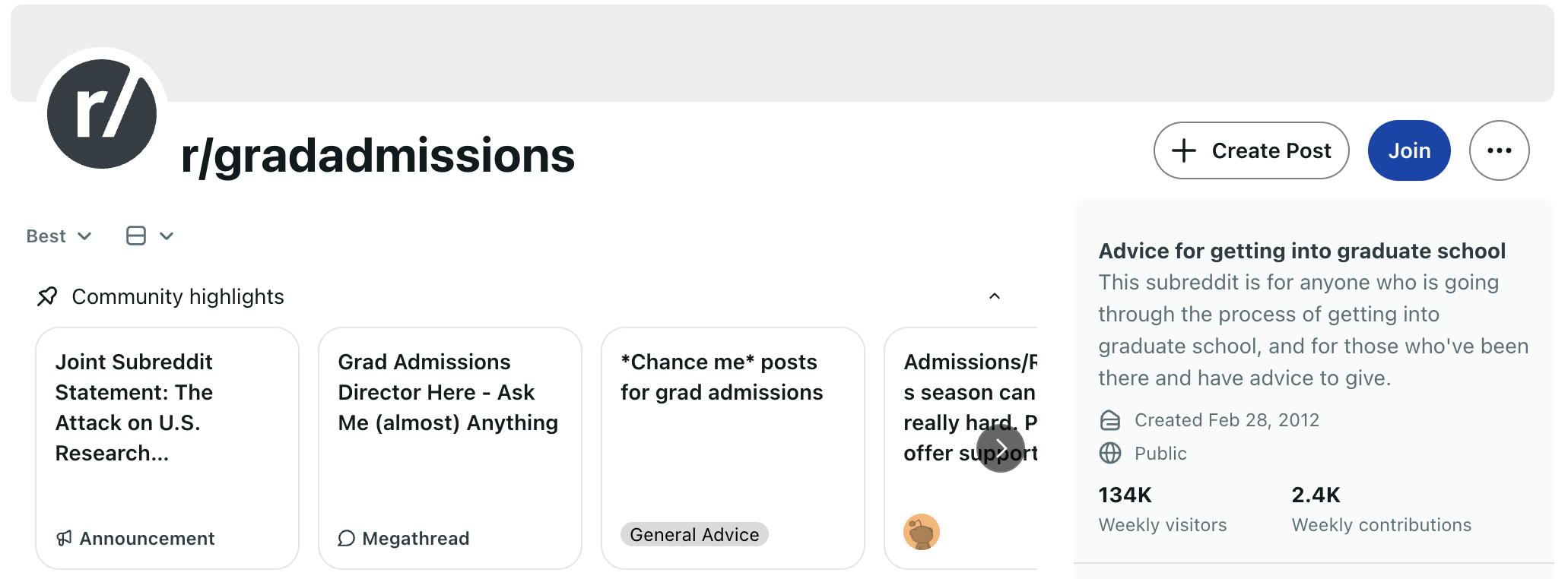
If you wish to partake, good luck and make sure to take extra good care of your mental health. If I were you, I would try to fight that urge as much as possible. But alas, each to their own..
February
Interview invites generally trickle in through the month of January. By the end of the month, most people have a sense of the options on the table.
If you’ve received an interview invite, massive congratulations! As is the case at most programs, your interview invite means that you have earned a place in what is a highly highly selective list of candidates. To give you a rough sense of the stats, a top neuroscience program (on average) will receive between 600-1200 applications and invite 20-70 to interview (the numbers will vary a fair bit across the board).
That’s between 2-12% of the applicant pool…
If you’ve made it this far, you should really pat yourself on the back! You have clearly worked very hard and have done something very right.
If not, also please don’t take it too hard. Decisions made by the committee can be made for all sorts of reasons out of one’s control. Keep your head up high. Programs can sometimes run a rolling process, some are also direct admit where a PI will reach out to you personally to set up a lab-specific interview.
It may also be that this was not the right year for you. Many incredible scientists I’ve met didn’t receive good news on their first try. They went back to their science and came back the next year or the one after that, stronger, more mature, and far better prepared to tackle the PhD. A disappointing cycle is not a verdict on whether you can become an excellent scientist.
What to do next?
Regardless of your outcome at this stage, there is no harm in making contingency plans before interview season ends and decisions arrive.
Before interview invites were finalized, I had made and communicated a concrete plan to return to the lab as a research technician if I received no offers in March. Looking back, it would also have been an excellent outcome: more time doing the science I had dedicated my undergrad years to, maybe a paper of my own!
There are also other options besides tech-ing. Though, I would favor the paid research-tech position or a structured postbac over an expensive, course-heavy master’s degree. A research master’s can be useful if it is funded and provides substantial independent research, but paying a great deal for coursework alone often does less for a research PhD application than spending that time in a good lab.
You can generally email inquiring about research technician roles. For post-bac, please see below for some structured options worth investigating (current as of Summer 2026; eligibility and deadlines change):
- [AMAZING, from my own observations] Harvard PiNBAC: two years of paid neuroscience research, curriculum, mentorship, and application support: https://www.pinbac.org/
- Stanford Medicine Postbaccalaureate Experience in Research: a paid, structured biomedical research year (10.5 months): https://postbacs.stanford.edu/about-the-program/
- MIT Brain and Cognitive Sciences Research Scholars Program: a fully funded two-year program spanning cellular, systems, cognitive, computational neuroscience, and neuroengineering https://bcs.mit.edu/postbac1
- Washington University Neuroprep: two years of paid neuroscience research and professional development https://neuroscience.wustl.edu/washington-university-launches-new-post-bacc-neuroscience-training-opportunity/
- UCSF PREP: 1 year https://postbac.ucsf.edu/
- PennPREP: 1-2 years https://www.med.upenn.edu/research-trainee-affairs/prep/
- [Lots of my fellow interviewees trained did post-bac here] NIH Postbac IRTA: 1/2 years in an NIH lab https://www.nimh.nih.gov/research/research-conducted-at-nimh/scientific-director/office-of-fellowship-and-training/fellowships-and-training-programs/postbaccalaureate-programs
- University of Kentucky UKNeu-PREP: a two-year, paid neuroscience research and coursework program https://medicine.uky.edu/departments/neuroscience/ukneu-prep
Interviews
Lucy Lai’s guide was absolutely spot on about all of this! Her descriptions, common questions, and advice were a great help (thank you so much Lucy). I won’t reinvent the wheel. You can find the link to her guide here. Please make sure to check it out, if you haven’t already!
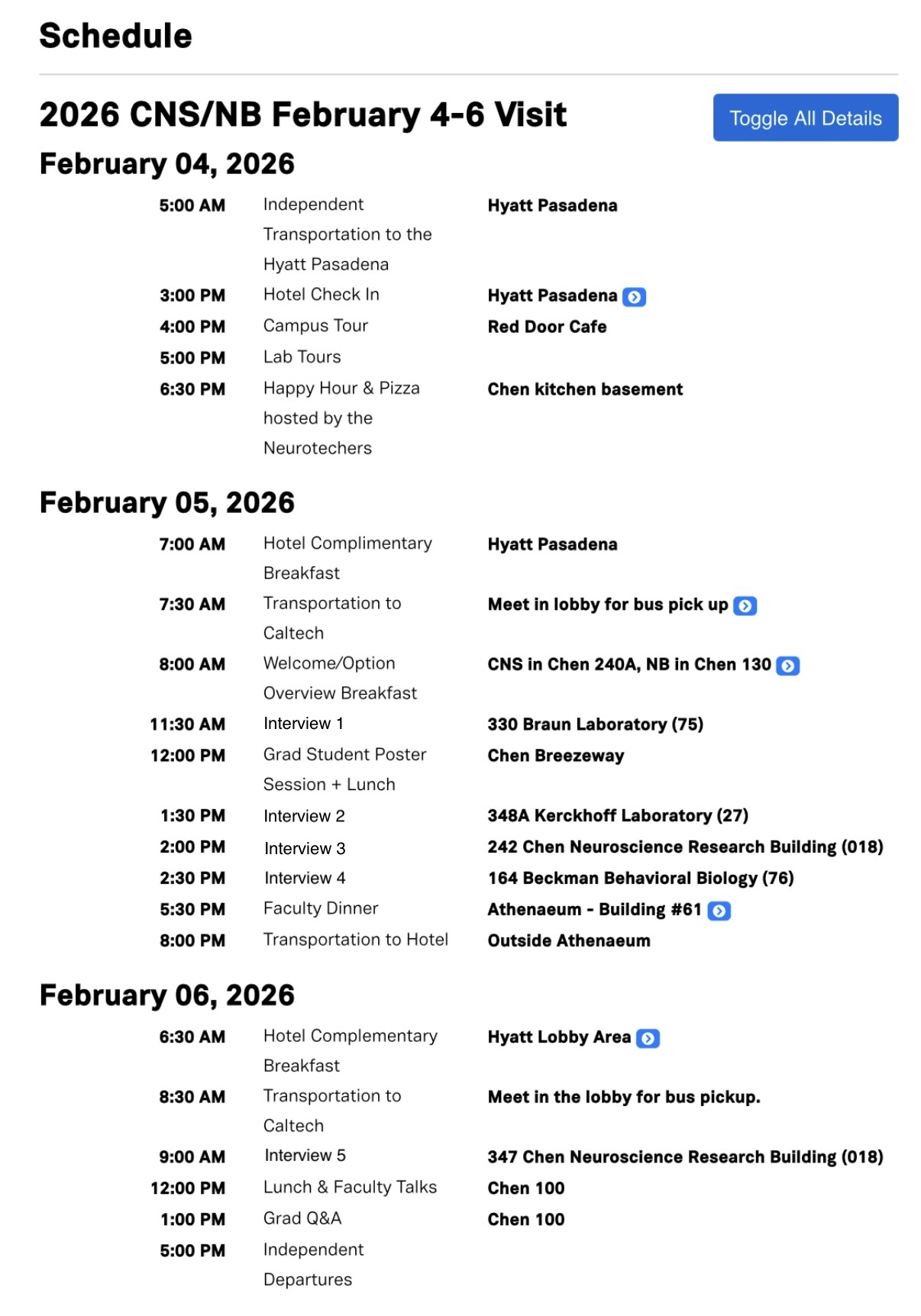
Instead, what I’ll do is attach my schedule from Caltech and add a couple small tips, thoughts, and unexpected things from my experience:
Schedule
My Caltech interview schedule
Commonly-asked questions:
And the details to consider in your answer
The vast majority of your interviews will start with:
1. “Tell me about a recent research project you were involved in”
A good answer will (in ~5 minutes):
1) Clearly articulate the motivating question
2) Concisely but powerfully introduce the stakes (why does this question matter)
3) Lay out a framework for the problem (how did you break this problem down)
4) Definitively state hypotheses
5) Present the critical pieces of evidence and provide well-supported interpretation
6) Logically motivate the next set of questions/experiments
7) Provide an opening at the end for your interviewer’s questions
8) Be told in a manner that inspires curiosity and excitement (any question can be interesting if you tell it in the right way)
Follow-up questions to this initial bit will take up the **vast majority** of the interview.
Good answers will:
1) Comprehensively capture the intention and nuance of the question being asked (questions can often be misinterpreted or misunderstood; don’t be afraid to ask them to “be more specific” or confirm if your interpretation is correct)
2) Directly answer the question with the necessary pieces of evidence, nothing more nothing less (rambling is often a sign that you don’t know what you are talking about)
3) Be confidently delivered after some careful thought
This takes a lot of practice. Mock interviews are really great ways to get good at doing this thinking on your feet. And often, by the time you have cleared the first couple interviews, you will have maxed out the “question-space” and heard most of the good questions that could be asked of your project (and therefore have well thought-out answers to them).
If they do get you with an excellent question you’ve never thought about, first of all, that’s awesome, it’s what you’d actually hope for in a productive dialogue; but, practically, an excellent tip I got from a former lab mate is to, whenever in doubt, propose an experiment. “I don’t know, but here’s what I would do to test and find out!” You might’ve lost a point on knowledge but you are definitely one step closer to convincing the interviewer that you’re a scientist (which is the ultimate goal of this interview anyway!).
Whatever you do, do not lie or make something up. This is probably the single worst thing you can do. Don’t do it.
2. Tell me about a time you failed
Science is a constant cycle of trial and error. When the going gets tough, your advisor wants to know you have what it takes to keep your head high, learn, and keep moving.
Can you think of an experiment that tested your patience and/or will? A time when you almost gave up? How did you solve the problem at hand (walk through your thought process and your honest inner turmoils)? How did you go about seeking help?
And arguably of most importance, what did you learn? What mindset will you bring into your PhD?
3. Why graduate school? Another version of this that I got was: Where will I see you in 20 years?
Avoid answer like:
1) I don’t know
2) It’s the logical next step
3) I want to have a PhD (no further explanation as to why)
4) My advisor told me to apply
*You get the gist…*
Your answer should reflect maturity and should show that you’ve clearly thought about how this PhD fits into your long-term goals.
4. Why this institution?
Each institution has its unique approach, training style, broader questions of interest, and cultural/geographic environment. These are all things you can tap into as you consider what really does make this institution suitable for your research. If you happen to have former colleagues or friends who are at these places, ask them what makes their institution unique!
Beyond these institution-wide generalizations, your answer should also have grounding in the faculty you hope to work with. Who are the 3 or 4 faculty you could imagine rotating or working with? What types of questions would you pursue with them? Get the admissions committee to easily imagine how you’d fit into their program!
5. What do you want to study?
If you have a clear idea, great. Articulate it well, but be mindful not to frame yourself as too narrowly focused and uninterested in anything else. I’ve seen this backfire. Try to incorporate other ways of looking at the question besides your primary approach. Link this to how faculty in the program might teach and support you.
If you don’t have a clue, that’s also fine. Provide the broader umbrella of ideas that excite you and how various faculty in the program are suited to guide you in your investigation.
Tl;dr any answer is fine, as long as you make clear why the program is suitable for you to study what you want to study.
6. What is your dream experiment?
Not that common, but I encountered it twice so thought I’d include.
This one is a fun one! Let your imagination run wild! It can be highly naive and ambitious or it can be super small and niche. Ideally though, you will ground the experiment in (1) a clear why (2) the limitations that keep you from doing it now (3) a general roadmap of how you would approach it.
7. Do you have any questions for me?
You should. You are not only trying to perform well. You are collecting evidence about the place where you may spend the next five or six years. (See March for a more comprehensive list of questions you could consider)
Reflections:
-
I found that having a short prepared spiel was quite helpful to start. Now please don’t mistake me when I say this, I do not mean that you should try to memorize and recite your answers. This is quite possibly the worst thing you can do. Your interviewers want to see you talk dynamically about your work, demonstrate your depth of knowledge in your specific domain + the field more broadly, and be able to field questions thoughtfully. Rather, what I mean is that it is nice to have a couple fallback lines to get you oriented when someone asks you “so tell me about a project of yours”. Interviews are nerve-wracking! Sometimes your mind can go blank. I found having some go-to anchoring phrases to be super helpful.
For example, I always started my answer to “tell me about a project” with, “the question that motivates my research in Bernardo’s lab is, how does cognitive flexibility change as we age?”
I would also make sure to always frame my explanation with the line “I approached this question at 3 levels. Behavior. Computational modelling. And neural recording of dopamine in the nucleus accumbens.” In this way, I could elaborate at will and change course as the conversation evolved but simultaneously have a familiar structure for the discussion.
-
You can’t “fake it until you make it”. The interview is truly a b***s***-proof test of how well you truly know your stuff. Before you walk into the interview, you should be well prepared to talk about everything AND more.
For example, I was asked about our choice of a behavioral task over another common one in the field. To answer this question comprehensively, you not only need to know your task well (descriptively) but also know the core advantage/elements it offers over another (which you also need to know well), and what particular detail in the setup that enables the advantage. Or, in another instance, I was asked about the sensitivity of our sensor and to elaborate on the lifetime setup utilized in one of our experiments. To explain thoroughly, you would reasonably be expected to know the rough Kd of your probe and how it compares to others. In terms of the microscopy question, I was glad to have brushed up on the photoelectric effect, PMTs, and fluorescence lifetime with my roommate (now pursuing his PhD in Physics at Stanford) in my preparation. If you independently led your project and were the primary decision maker, you should generally be okay. Often though, you are working with a grad student or postdoc who is more so guiding the project. Make sure that you have very thorough discussions about the choices made for your project and also learn how to make these decisions for yourself. It is highly beneficial not just for achieving success with the interview but also for your growth as a scientist. I guess the tl;dr here is to prep anything and everything and dig as deep as you can into the why of every choice you made in your project! Presenting posters or giving lab meeting on the project is also excellent practice along the way.
-
Read far and wide. It is not enough to just know your project. The most mature candidates will also be able to tell you how their work fits into the larger literature, reference key papers that are shaping ideas in the field, and be able to engage with the interviewer’s research and broader interests.
I will never forget an out-of-left field question I got about the hedonic dimension of negative outcomes (literally, “why do I feel disappointed when I can’t catch a fish”). I scrambled to think up a subpar answer about how dopamine does not itself encode “liking” and went on a tangent about iSPNs, the indirect pathway, and negative reinforcement. If I had done my homework, the far better answer would have been clear for anyone to see in Kent Berridge’s 2014 NAcSh hedonic hotspot paper. There really isn’t a good way to prepare this, it really has to be built from years of close reading and thoughtful engagement with the scientific community. Best to make consistent journal club attendance and biorxiv-browsing habits of yours early on!
-
Don’t let your nerves get in the way of your curiosity! My most successful interviews were my most fun ones. In my experience, (the vast majority of) PIs are not out to get you. They’re taking a workday or a weekend out of their busy schedule to sit with you and yes they are evaluating you but really they are also trying to meet the young minds that are going to add color to their research programs. As such, you can very easily make it fun and interesting for the both of you by teaching them something they don’t know and by learning something you didn’t know. Being a passive responder to their pre-written list of questions sort of sucks for both parties. Brainstorm together! Draw things on the board! Push back on something they wrote in that recent paper with an observation you made in your own experiments. The more you let your curiosity run free the better. I realized this maybe halfway through my interview cycle, and after I made a conscious switch, I started to have a lot more fun. Coming out of the month, I found myself both enjoying my interviews so much more AND feeling better versed about my field and what people were thinking about!
-
To read or not to read (your interviewer’s papers)? My take is yes. There is a pretty low probability your interview will get onto the topic of a specific paper. It is also definitely not expected that you know specifics about the work they’ve done. I more so advocate for this because this is reading you should be doing anyway. The PI job market is and always has been brutal. Being a PI at a top research institution means you have done some very important and cool work. You ought to read their work if not to just learn more, frame your thinking as comprehensively as possible, and inspire new ideas for your future work! It’s also always nice if something in your work adds a little perspective to something in the PI’s work, and you can only come across these small coincidences if you’ve read closely.
-
You start to see the same people everywhere. Not just at the interviews but also at conferences, meetings, workshops, in the latest issue of that journal. In many ways, your interviews are also sort of your first professional networking event! Be kind and thoughtful! Be willing to make friends! Have fun at the events! These are the first memories you make with colleagues you will run into time and time again.
Additional (bulletpoint) thoughts and reflections:
- The interview process is truly the best learning experience and eye-opening experience you can have as an aspiring scientist. You get the chance to interface with some of the leading minds of your field and discuss ideas. Most recruitment weekends will also have some of their coolest professors and grad students give talks. Truly just such an incredible learning experience!
- Do mock interviews, as many as you can, with people doing as many different types of science as you can find. A diverse set of questions will bring out knowledge gaps you had no idea existed. And often, it is the naive questions that are most dangerous.
- So cool to see different parts of the country, fully paid for
- Every school has a personality and questions they are interested in, you get a feel for it pretty quick.
- Jot down your notes and the vibes. You’re among their top candidates. You are interviewing them just as much as they are interviewing you.
March
Decisions begin to be released around this time, sometimes earlier. I have my fingers crossed for you :D
If you’ve been accepted, congratulations 🥳 and I hope you are incredibly proud of this achievement. I hope you also take a moment to recognize how much you have grown through the process. You did it!
A quick note on thank-you emails
I do not think a thank-you email is required after every 30-minute conversation, nor should you expect it to change an admissions decision. I did send short, personalized notes when someone had been especially generous with their time (faculty, student-interviewer, program coordinator, staff), when we had a substantive scientific/personal conversation, or when I just really appreciated someone. Two or three specific sentences are enough, but make sure to be genuine and specific in your note about what you are grateful for. A generic essay to every person you meet is a waste of both your time and the receiver.
Declining offers
Once you know that you would not attend a scheduled interview or accept an offer, tell the program coordinator as promptly as you can and do so graciously. You do not owe anyone an elaborate explanation. Thank them for the opportunity, say that you have decided to withdraw or decline, and wish the program well. Importantly, releasing a place promptly may help another applicant. I do believe that if a faculty member invested substantial time in recruiting you, it is kind to send them a separate personal note.
Waitlists
I did not have a waitlist process, so I do not want to manufacture advice from experience I do not have. I have asked Cherry to contribute a short section to the addendum about what the process looked like from her side (see below)!
Now your next big decision comes on (or more likely before) April 15.
In this window of time, you should (1) rest/relax but also (2) gather as much information as you can to make this decision in a comprehensive and informed way!
I remember spending quite a bit of time in March trying to speak with members of prospective labs, program students, alumni, and potential mentors.
Looking back at my own notes, I tended to ask a lot about intellectual direction, day-to-day mentorship, independence, techniques, collaboration, graduation, social life, and geography.
Key note: A program will always describe itself as collaborative and supportive. Your assessment should come from tangible examples and whether faculty, junior students, and senior students tell compatible stories. And to get the real scoop, save the more sensitive questions for students when faculty are not present.
Here is a non-exhaustive list of questions I had jotted down in my notebook:
Questions for a potential advisor
- How are projects chosen? Do you (the PI) assign a question, develop it jointly with the student, or expect the student to design it?
- How often do students meet one-on-one with you, and what happens between meetings?
- How do you (on your best day) aim to respond to failed experiments, bad news, or a student who disagrees? What is your philosophy on helping a student navigate failures and difficulties?
- What are your lab’s most exciting current or unpublished directions?
- What have recent students published, how long did they take to graduate, and where did they go next?
- What technical and conceptual skills do students from your lab learn? What specific components do you prioritize in your training?
- Can students collaborate or be co-mentored across labs?
- How do you/do you support students whose goals are industry, startups, policy, teaching, or other paths outside the professoriate?
Questions for current lab members
- What does an ordinary week actually look like? How often do you work nights or weekends, and can you take vacations?
- Are you happy? What is the best part of this lab, and what is the part recruits don’t really hear about?
- How available is the PI when a project is stuck? Who provides your day-to-day technical training?
- What is your view on your PI’s (reported) training style? Have you been able to build a productive and supportive working relationship?
- Do you agree with PI’s answer on failure/difficulty navigation? How consistent are they with their ideal behavior?
- How are authorship, project ownership, and disagreements handled?
- Has anyone left the lab or changed advisors recently? What happened?
- If you were choosing again, would you join this lab?
- What have you learned in the lab? Do you think you are prepared for your next step, whatever that may be?
- What are your long-term goals?
Questions about the program and ordinary life
- What happens if none of your rotations works out, you need to switch labs, or your advisor loses funding or leaves? Who pays you during a transition?
- Is funding guaranteed for the full PhD? What fees come out of the stipend, and how far does it go after rent, taxes, transportation, and healthcare?
- What are the median time to degree and attrition rate (empirically, not the official ideal timeline)?
- What teaching is required?
- What career development exists for the paths you care about?
- How usable are the health insurance, mental-health care, disability accommodations, parental leave, and other family support?
- Is there a graduate-student union or a truly independent person to approach when an advisor relationship goes wrong?
- Where do students live? What is the commute like? Is it easy to build a social life and support network there?
- Can I see your apartment (you will get varying levels of enthusiasm in response)
Also, you do not need to ask every question in every conversation. Choose the ones that bear on your own happiness and risk, and jot down the answers immediately so you don’t forget your initial response/impression. When unconvinced of an answer, ask for specific examples! These are often far more informative than reassuring adjectives.
April
Here is how I weighted the factors in my own decision at the time. This is descriptive, not a formula I would advise everyone to copy. Your health, finances, family, identity, support needs, and tolerance for risk may produce a very different weighting:
- Research mentor/lab fit (80%)
- Location and environment (15%)
- Cohort (5%)
Research Mentor Fit
I chose to hinge much of my decision on the people I expected to spend the most time with over the next 5-6 years. If we break down the 7 day week, on average, you will spend 9-5, 5 days a week, in one lab working with one mentor. Just based on this simple calculation of time, I’d choose to weigh this most. On top of this, your mentor will also likely be one of the most defining people in your early career. Your lab mates are going to be the people you see the most and collaborate with/learn from the most. I would thus reason that it is quite important to have a good fit both ways.
One additional caveat I’ll put in here is that I was, on multiple occasions, told to be very cognizant of a mentor’s funding situation as part of the fit equation. If a lab’s research and culture are completely up your alley but the funding situation may prevent the PI from taking or supporting you, ask direct questions and treat the uncertainty seriously. In a rotation program, I would also avoid evaluating the offer around only one dream lab: confirm that there are two or three plausible alternatives and understand what protection the program provides if a rotation match fails.
Location and Environment
This obviously differs person to person and things like location can matter a lot more circumstantially (you have dependents that you want to be close to/ your life is quite rooted in one place already). I had a fair bit of flexibility in terms of my location and so a lot more of this consideration came down to what type of city I wanted to live in. Having lived in Boston for the last 10 years, I felt it was maybe a good idea to explore a different part of the country. The west coast had a very novel appeal to me and I wanted to experience life in the sun. So it came down to SF, LA, SD. Each of these places is absolutely wonderful and it was a tough choice. Therefore, I defaulted to research fit at the end of the day.
Cohort
Several friends in graduate programs told me that after first-year coursework, day-to-day scientific life often shifts toward the lab and friendships made across the institution. That is why cohort fit carried less weight in my own decision. I may revise this view with experience, though: cohort and program culture can matter enormously during rotations, qualifying exams, advisor conflict, and ordinary life, especially before you have found your long-term lab community.
Please note that this is all just my own opinion. I realize everyone has different priorities and different needs, so please (again) take this all just as a point of view for reference!
All of this led me to decide on Caltech! I’m really looking forward to the assortment of projects and opportunities the department has to offer and to living life in LA to its fullest.
May and onwards
Congrats again on making it all the way! Rest up, relax, enjoy this wonderful time before embarking on this new journey! This is where I find myself now as I am writing up these reflections.
It took a whole village to bring me to where I am today. I owe every bit of my learning to my mentors, instructors, friends, and family who I am truly so lucky to have in my life.
I hope this was helpful and I wish you all the very best on your process. I will continually update this as I experience and learn more through grad school! As stated in the beginning, I will also link my essays, in case you need an example to get started. In the meantime, be well and good luck!
Signing off,
Sean
NSF GRFP
This resource was super helpful. NSF GRFP Examples (See Alex Lang’s NSF GRFP blog post). There, he also lists the questions on the application.
I don’t have very much to add to this. I was successful in my application and plan to be supported years 3 through 5. I don’t have a clue how my application ended up doing well among the many impressive applications that went in.
My general advice would just be that it’s quite important you start early and communicate frequently with your PI about the research proposal. They will have invaluable wisdom.
Additionally, try to treat this writing process as a creative growth/learning opportunity. For most of us, this will be our first “grant” (of many)!
What I will do here is attach my statements as well as the comments from reviewers (if and when they release them). Hopefully you can take something away from it!
Addendum
US (a second opinion)
Cherry Chen at the Rockefeller University
Thank you Sean for inviting me to reflect on my experiences. Honestly, I don’t have much to add beyond what’s already covered so thoroughly, so I thought I’d share some cautionary tales that turned out fine, in the spirit of staying sane during application season. I hope it’s reassuring to see how much can go a little sideways and still work out. (Please don’t try to replicate these before your interviews.)
A bit about my background: I applied as a senior at Stanford majoring in math and biology (neuroscience concentration) with a CS coterminal masters. I spent 3 years working with Liqun Luo and my amazing grad student mentor Alina Xiao studying serotonin in behavioral flexibility. I led a thesis project and assisted with some other projects/experiments.
Interview mishaps
It’s so easy to spiral over small mishaps, and I’ve definitely cringed replaying some of my own interview moments in the middle of the night. Here are some uh-oh moments from 3 (thankfully) different programs. Hopefully, reading this can make you feel better when you’re stuck reliving conversation in your head.
- Forgot a detail: Study all your experiments in as much detail as possible but if something slips your mind, it’s not the end of the world. I was asked about the architecture of a model I’d used for a project a while back and couldn’t explain it clearly, so I rambled (like Sean said you shouldn’t do). In hindsight, I could have just said“it’s been a while, I’ll have to check on the details”. We quickly moved on to discuss other experiments and I caught the interviewer the second day and gave the correct answer.
- Random questions: You don’t need perfect answers for every question interviewers throw at you. Not everyone knows everything and sometimes they might just be curious, like we all are when discussing science. I once got asked what the single most fundamental role of serotonin is, dopamine-for-reward style. Nobody really knows, so I gave my best naive guess, and it turned into a great discussion.
- Late to an interview: Do not do this. I showed up 10 minutes late because my previous interview ran over and I got stuck in a building due to access issues. The PI then said he had to go pick up his kid and ended the interview early. I genuinely thought I’d blown it, but these things happen and interviewers understand more than you’d expect.
- Sudden change of schedule: I sincerely hope this never happens to you, but very rarely an interview might get rearranged with short notice. I found out I had a new interviewer half an hour beforehand, with zero information about them going in. So I did what any rational person would do and mildly spiraled, but the PI knew about the mix-up, apologized, and we ended up bonding over our mutual love of pup care.
Reading this might make interviews sound horrifying, but they were actually 99% enjoyable. If there’s one thing to take from this list, it’s that none of these moments felt small at the time and all of them turned out to be not important for the outcome. You can’t prepare for every scenario, and a rough moment doesn’t have the power over your interview that it feels like it does in the moment. Trust that you know your science, and focus on what’s next.
Waitlist
The first decision I received was a waitlist from Harvard PiN, and I won’t pretend that it didn’t sting. Naturally, I fixated for a while over things I could have done better: maybe I shouldn’t have complained about Boston weather so much, maybe I should have asked more questions during the talks, maybe I should have chatted with more PIs during the mixer. Alas, we will never know the real reason and I cannot change what’s already happened. However, thinking back now, it might have been a good thing because I was more than ever motivated (by spite perhaps) for my next interviews and later had options that I was genuinely excited about.
If I could pass along one thing from that experience, it’s that you’re not defined by a single decision. Admissions committees are inconsistent, timelines are messy, and one early “no” (or “maybe”) says very little about how the rest of your cycle will go.
What to do:
- If the program is still a top choice, check in periodically to reaffirm your interest and see if there’s movement (this may also help your position on the waitlist). Programs tend to be vague about waitlist timelines and odds, so if you especially bonded with an interviewer, it can help to reach out to them directly for clarity or support.
- If you’re no longer interested, let the program know right away.
One final tip is to keep an open mind about programs and labs, since you never know what a place is really like until you visit, and lab websites are (shockingly) not always fully objective.
During the interview weekends, I learned a lot about cultures and living environments that changed my previous impressions. Fit is completely personal, and a program that feels perfect for some might not be the right place for you. After my visit to the Rockefeller, I found myself constantly imagining thriving in this stimulating research community so I accepted the offer shortly after.
Unfortunate moments aside, this application season was, by far, the most rewarding and memorable experience I’ve had. Getting to spend a few fully-paid days at top institutions, geeking out about science with peers and experts in the field, and learning about the exciting work happening there is a rare privilege. Enjoy it while it lasts, and good luck!
- Cherry
UK
Nathan Ewer at the University of Oxford
A funded PhD position is an investment. You invest several years of time with reduced earning potential for domain skills, knowledge, and connections. University invests tens to hundreds of thousands of dollars in you. Both parties are hedging bets on your future success, whether that be high net worth, publications, press/media coverage, a prestigious job or startup.
How will institutions predict whether you will be successful? Your past success and current growth rate are the primary metrics. Hence, the probability of your application succeeding depends on 1) alignment of these variables to the target vocation and 2) how well you communicate this alignment.
To achieve these criteria, follow three practical steps:
- Determine alignment criteria.
- Visit the PhD course website
- and view sector adjacent job listings (e.g. Anthropic Research Scientist, Life Sciences). Aggregate key responsibilities, minimum and preferred qualifications, and skills (skill map)
- (and) identify relevant programs from funding bodies for high risk research, e.g. DARPA, ARIA, etc (frontier domain map)
- Set skill, knowledge, and connection targets. Compare your existing career capital to the entry requirements and skill map. Identify:
- What projects with measurable outputs (publication, essay, open source contribution, award, etc) will demonstrate specific skills on the skill map?
- Which projects align with areas in the frontier domain map or research programs you are interested in?
- Which people, including peers, mentors, and communities will make your project competitive (motivation/consistency, novelty, quality, prestige)?
- Create a roadmap of projects and courses to maximise these criteria in the time available. Execute the plan. Tips:
- Be critical of the time available.
- 1-3 years of foresight is transformative, aim for a series of deep projects to place you in the top 1%.
- 6-12 months is powerful, aim for 1-2 deep projects over several small ones.
- 3-6 months is useful, focusing on refinement of previous work and smaller, targeted projects.
- 1 month is frozen, focus solely on the application itself.
- Projects should be set at a level of desirable difficulty.
- Habit is your hammer. With consistent practice, actions (physical or cognitive) become procedural knowledge which can be executed without costing any working memory. You will achieve more for less effort, which is essential for performance at the highest level.
- Use projects as a forcing function for new relationships (peers/mentors); document your project progress, email academics with comments on how your research could complement theirs (collaboration) or inquire on the pressing issues in their domain (gaps), etc.
- Determine what you need to do in series, e.g. do you need to learn linear algebra before starting deep learning?, and what you can do in parallel, e.g. making a personal portfolio website doesn’t require deep learning knowledge. Prioritise foundational skills early.
- Maximise feedback. Share with your peers and mentors consistently. Ask for advice consistently. Thank them consistently. Take advantage of extended cognition.
- Be critical of the time available.
Background
I received full funding for the ENAIBLE CDT program at Oxford. Below I outline points of strategic interest for successful application.
1 Course Structure:
There are two available DPhil structures at Oxford:
- Direct Entry: Application is direct for a specified lab, requiring a research proposal for a specified project. The DPhil is funded for 3 years full time.
- Centre For Doctoral Training (CDT): Application is for a specific CDT program, which involves 1) a training year with 3-6 months of taught modules + two 3-4.5 month lab rotations, 2) 3 years thesis project in a specific lab. The DPhil is funded for 4 years full time.
Application strategy for direct entry is equivalent to that discussed by Sean above, with initial applications opening October, closing December, interviews in February, and place confirmation by July. The precise timeline will depend on course, with specific advice available on the Graduate Admission page.
For CDT programs, application timelines are equivalent, but the training year course structure changes the focus from a research niche (a lab, a PI, or a project) to a research theme (a set of labs, PIs, or projects). In your SoP and interview, you will need to demonstrate knowledge of the relevant research themes with specific examples.
China
Jie Yang at the Westlake-SMART Joint Program
First of all, I would like to thank Sean for inviting me to share my experience of applying for PhD programmes. I have been meaning to write something that might be helpful to friends who are considering a PhD for quite some time, but for one reason or another, I kept putting it off.
A Little Background
I studied Veterinary Medicine at Shihezi University, a relatively unknown university in northwestern China. The degree programme lasted five years. During my second year, I joined a research lab because I found studying theory alone rather tedious. I wanted to gain hands-on experience and see how the knowledge I had learned could be applied in practice.
1. My first lab worked on bacteria and bacteriophages. There, I learned basic experimental techniques, including PCR, Western blotting, and bacterial culture. I also led a national-level undergraduate research project, which may—or may not—have helped strengthen my application profile.
2. After gaining some initial research experience, I completed a four-month internship during my third year. By chance, I came across an internship advertisement from a principal investigator at the Chinese Institute for Brain Research (CIBR). After reading about several PIs and their research interests, I decided to send out a few emails. Eventually, I joined the Koziol Lab for my first internship. This was where I was first introduced to neuroscience and began studying the molecular mechanisms underlying neurodegenerative diseases.
3. My third research experience was my final-year project at Shenzhen Bay Laboratory. My supervisor there is now also my PhD supervisor. This was where I began working on synapses and memory.
Common Pathways to a PhD in China(Which might not be as straight-forward as the US/UK system)
Pathway 1: Take the National Postgraduate Entrance Examination, Complete a Master’s Degree, Then Apply for a PhD
This is the most conventional and widely used route. Students who do not qualify for a recommendation exemption—known in Chinese as baoyan, or a graduate admission waiver—must take the highly competitive National Postgraduate Entrance Examination. After passing the exam and completing the subsequent interviews, they enrol in a master’s programme, which typically lasts two to three years. Once they have completed their master’s degree, they can apply for doctoral programmes through another competitive application process. Many universities now use an application-and-assessment system for PhD admissions. This pathway is especially common among students who did not receive a recommendation exemption, as well as those who want to change fields or attend a more prestigious institution for graduate study.
Pathway 2: Obtain a Recommendation Exemption for a Master’s Degree, Then Apply for a PhD
Students with strong academic records—typically those ranked in the top 10% or higher of their cohort—may be nominated by their undergraduate university for a recommendation exemption. This allows them to enter a master’s programme without taking the national entrance examination. After completing their master’s degree, they apply for PhD programmes in much the same way as students in Pathway 1. However, they often have an advantage: they have already been recognised as strong students and may have gained more research experience or developed closer relationships with potential supervisors.
This route is well suited to students who have demonstrated strong academic performance and early research potential but are not yet ready, or do not have the opportunity, to enter a direct PhD programme.
Pathway 3: Direct-Entry PhD through a Recommendation Exemption
A small number of undergraduates with outstanding grades, substantial research experience, and exceptional potential may receive a recommendation exemption that allows them to enter a PhD programme directly, bypassing the master’s stage altogether. In China, this is often referred to as a “straight-to-PhD” or “direct-entry doctoral” programme. The total time to degree is usually five to six years, compared with seven years or more for students who first complete a master’s degree.
Pathway 4 (This is the route I chose. ): Apply Directly to a PhD Programme after a Bachelor’s Degree, without a Recommendation Exemption
As far as I know, Westlake University is currently the only university in China that offers this pathway. However, it is similar to the standard PhD application process used by many universities in the United States and the United Kingdom.
Under this system, students can apply directly to a PhD programme after completing their bachelor’s degree, without needing a recommendation exemption from their undergraduate institution. Applications are assessed entirely on the basis of the applicant’s own qualifications, including research experience, research proposals, publications, letters of recommendation, standardised test scores such as TOEFL(90 and above) or IELTS scores, where applicable, and a clearly articulated statement of research interests. The process is also broadly similar to the one I went through when applying to universities in the UK and the US.
| Pathway | Features | Suitable for |
|---|---|---|
| 1. Graduate Entrance Exam → Master’s → Apply for PhD | The most traditional route: you take the National Postgraduate Entrance Examination, complete a Master’s degree, and then apply for a PhD program. | Students who did not obtain recommendation exemption status, or those who wish to switch schools or majors. |
| 2. Recommendation Exempt Master’s → Master’s → Apply for PhD | You receive a recommendation exemption from your undergraduate institution, enter a Master’s program without entrance exams, and later apply for a PhD after finishing your Master’s. | Students with excellent undergraduate grades and a strong research track record. |
| 3. Direct Entry PhD via Recommendation (Skip Master’s) | With recommendation exemption, you are admitted directly to a PhD program, bypassing the Master’s stage altogether. | A very select group of students with toptier undergraduate performance and exceptional research potential. |
| 1. Direct PhD Application after Bachelor’s (No Recommendation Required) (Currently only Westlake University) | No recommendation exemption is needed; you can apply directly after graduation, similar to the directentry PhD model commonly used in overseas universities. | Undergraduates with a solid research background and clearly defined academic goals. |
Initially, I was preparing to apply for PhD programmes in the UK and the US, so I decided not to pursue a recommendation exemption. As a result, all of my application materials were prepared according to the UK/US application system (you can refer to Sean’s section for more details).
Here, I would like to share my experience of interviewing for the Westlake–SMART Programme.
The interview process took only two days in total. On the day of the interview, candidates first arrived at SMART (the Shenzhen Medical Academy of Research and Translation) and presented their ID card and admission ticket for verification.
Candidates were assigned to either a morning or afternoon session and divided into different groups. Each interview lasted approximately 25 minutes and consisted of three parts:
1. Chinese-to-English translation: Basically, they would give you an abstract from a paper(English) and ask you to read aloud to test your oral English ability, after which translating it into Chinese(just interpret) to test your English reading ability(But I am sure they won’t ask you to translate English into Chinese if you’re a foreign). (around 5 minutes)
2. A presentation on your research experience and research proposal (approximately 5–10 minutes). You could present in either English or Chinese using PowerPoint slides.
I think this part really tests the depth of your research thinking and your ability to reason logically, since you need to explain an abstract concept to a group of PIs who may not be in your field.
What helped me stand out in this process was the consistent practice I did with my classmate, Yikai Zheng. He really helped me improve the logic of my presentations—especially how to explain a concept in one sentence and make my work easy for others to understand.
One thing I learned is that you can simply talk to people whenever you meet them during coffee breaks or at symposiums(do not be shy, JUST DO IT). Try explaining what you do, why it matters, and why you chose to work on it to people from different backgrounds. The goal is to help them understand your work. Of course, if your research is highly confidential, it is better to be a little more cautious—haha.
3. A question-and-answer session based on your presentation followed. This was probably the most challenging part. If I remember correctly, there were around six PIs in the room, and their questions could be very sharp and insightful. I still remember one PI asking whether the mutant mouse model I used was a knockout (KO) or conditional knockout (cKO), and why I had chosen that approach. Another PI asked about my research proposal: “What would you do if your proposal did not work out in your second or third year?”(For this question, I think I reply like this : I would treat it as a signal to reassess rather than simply as a failure. I would determine whether the problem came from the hypothesis, the model, or the methods; discuss it with my supervisor; and adjust the project based on the evidence.) Naturally, the experience also depended on which PIs were assigned to interview you.
Tips: I think for this part, if the questions are about your science and project, make sure to be detailed with every single experiment that you did(Just like Cherry said), its purpose, how you designed your experiment, how you did it, and what conclusion you can draw from your data. And for other open questions, give the open answers. I think the most important thing is to show that you are the person who dominates your project and you know yourself better than anyone else. Just show them you have thoughts.
After the interview, all of the PIs present scored each candidate’s performance using their own evaluation criteria. Once that was done, your PhD interview was over.
Hi guys, if you are reading this, you have reached the end of this guide. But remember: your exciting new chapter is only just beginning. I hope you receive the offer you are hoping for, and I encourage you to welcome whatever comes next with confidence.
No matter where you end up, keep loving life. This journey may be full of thorns, but perhaps that is what makes the roses along the way so beautiful.
-Jie
Acknowledgements
I’d like to thank Cherry Chen, Nathan Ewer, and Jie Yang for their thoughts and contributions to this piece. I’m grateful to Cold Spring Harbor Asia (particularly to Tianyi Mao and Yulong Li) for bringing us together and inspiring the compilation of these perspectives. I’d like to thank Ben Chang for providing helpful comments and encouragement. I’d also like to thank Kevin Mastro who was the original source of all my insights into this process.
Good luck everyone!